Saturday, December 18, 2010

2010 Alice Ogden Christmas Ornament


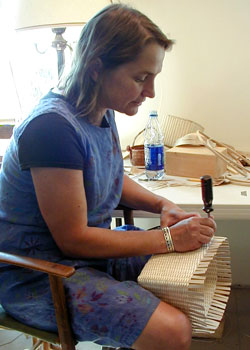
Alice Ogden of West Franklin, NH outdoes herself again this year with another incredibly beautiful basket for my Christmas tree. Measuring only 1" wide x 2" long x 1 3/8" high it is a perfect scale replica of her full size double swing handle basket. Alice has making black ash basket ornaments since 1995 with a new design each year since 1997. I am fortunate to have all of her designs gracing my tree (which I actually leave up all year in my weaving studio).

Alice not only processes all of her splint and hand carves all of her white oak handles and rims she is also a great basket weaving instructor. I made a full size version of this basket back in 2003.

8" l x 5.25" w x 5.75" h

Alice packing one of her full-sized double swing handled baskets.

Monday, November 29, 2010

Pin Cushions

I have been playing with felting more wool lately. I recently made a trip to some thrift stores and bought some old wool sweaters and blazers. The sweaters took about 3 good wash cycles in hot water to get them to fully felt and boy was that crazy. I will have to post more on that later and take before and after photos. It is a sight to behold a man's XXL 100% wool sweater becoming a child's size garment. Of course by the time it is that size it the wool is so thick and dense that a kid wouldn't be able to put his or her arms down!

For the wool blazers I had to cut them apart first before felting. They too shrunk, but the effect wasn't as dramatic since they were just strips of fabric. One of the blazers (the red fabric in the photos) was already made of felted wool so I didn't run it through the washing machine. I used this felt to make pin cushions. I found the pattern on Etsy and decided to give it a try. I am not the best at sewing or decorative stitching, but I thought they turned out fairly well. The later ones definitely turned out better.
They range in size from 2.5" to 4.5" in diameter.


I am excited to try some more. While I have plenty of the three fabrics left I really want to find some more colors. While searching for buttons at my grandmother's I found a few scraps of old wool. I am going to try to felt it (hopefully it isn't too moth eaten) and make a special one out of it including a button from her button box. That one will definitely be a keeper. The other ones I will probably give away as little favor/gifts. I mean, how many pin cushions does one person need? Of course how many baskets does one person need? But, that has stopped me from hording those!

Wednesday, November 10, 2010

St. Louis Post Dispatch - local basket maker feature

This article recently ran in the local news paper. Mary Makuta took that first Shaker basket class here at my house at one of the workshops I host. Since then she has taken almost 20 classes from my guest instructors.

Made in St. Louis: Mary Makuta
BY KAREN DEER
Sunday, October 31, 2010
Mary Makuta from Ballwin displays
some of her basket creations
Wednesday afternoon.
• How did it start? I was taught crochet and hand embroidery when I was 10 years old. By 13, I was designing and sewing my own clothing. Later, I began making my own draperies and becoming acquainted with fiber arts. In 1992, I became a porcelain doll artist. Years later, I created totes and handbags made of natural fibers. In 2004, I was introduced to the lost art of Shaker basketry. I attended a class taught by a well-known artist, Martha Wetherbee, who has devoted her life to preserving the art of Shaker basketry and other American 'signature style" baskets such as the Nantucket lightship basket. During the class, I created a small basket and fell in love with the wood. It's like satin.

• What is a Shaker basket? The basketry originated in the 1700s in New England. Most consumers are familiar with Shaker furniture. It's very valuable. The Shakers of New England made outstanding fine arts such as furniture and baskets. A Shaker basket is made from the black ash tree grown in New England. To create a basket, the tree is cut down, hand-pounded, stripped, split and sanded.

• What are your prices? My Shaker baskets start at $100 for a 5-inch basket, which is made of all wood. I also sell Nantucket baskets. Prices start at $75 for a Nantucket penny basket and up to $750 for a 13-inch Nantucket tote.

• What else do you make? I create a hybrid purse made of ash or it can be made of cane. It's created the same way the Shakers prepared their ash 200 years ago. My hybrid purses start at $275. Some of my purse lids feature learned marquetry, an inlaid wood. They start at $500.

• How long does it take to make one basket? It takes a month because of the carpentry process and the wood finish process. I also design a liner for the basket made of silk or wool.

• Do you teach basketry classes? Yes. I have a workshop in my home, and my students choose an item to work on. I'm there to guide them through the process.

Copyright 2010 www.STLtoday.com. All rights reserved.

Wednesday, October 27, 2010

2010 JoAnn Kelly Catsos Worshop

Wow, I can't believe JoAnn's workshop was already a few weeks ago? October has just flown by and I have been sooooooo bad about updating my blog.

Well I finally got some photos from class up on my JASkets facebook page. If you aren't a fan you should become one. You can keep updated on my day to day activities. It was fun posting pics live from class with my new iPhone. My camera still takes better photos and some are below. JoAnn taught a cute little 1/2 scale Shaker knife basket and a 6" Shaker quadrafoil woven with super fine splints.

Tuesday, October 12, 2010

Recent Works: Aaron Yakin and Cynthia Taylor

September 18 – November 27
Balcony Gallery
The Bascom
P.O. Box 766
Highlands NC 28741

Egg Basket with Side Handles, #98-18
15" x 13" x 6"
Cynthia Taylor
(From my personal collection)

Take a glimpse into the current work of artists from The Bascom collection. Masters of tradition, West Virginia basketmakers Aaron Yakim and Cynthia Taylor make traditional Appalachian white oak baskets straight from the tree.

The Bascom is an arts education center and tourist destination serving audiences in Western North Carolina and beyond with unique cultural experiences. Discover free-admission art exhibitions, plus skills-building studio art classes, curatorial talks and multiple-day festivals. Completed in 2009, The Bascom’s six-building, six-acre campus offers pastoral grounds, panoramic views of the Nantahala National Forest and spectacular architecture, such as an early 1800s covered bridge; vintage-wood pottery barn; and a main building constructed of barns, glass and steel. Amenities include a pet-friendly nature trail, seasonal Cafe and Shop, and limestone terrace for venue rentals.

Kentucky Egg Basket
13" x 9"
Aaron Yakim
(From my personal collection)

Sunday, September 12, 2010

Finishes on Baskets


Below are a couple of responses I posted in Weaver's Words when the question was posted concerning applying finishes to baskets.

Weaver's Words - March 25, 2007
Tung Oil as a stain - Tung oil is a sealant and not a stain. It is going to seal the fibers of your basket and make the weaving rigid. If you are making a Nantucket style basket then this is fine, but for use on a reed, oak, willow, ash basket it is not advisable. You could use it on a wooden handle or base, but I wouldn't use it on the weaving. If you want to darken or color your basket I would suggest using Minwax brand wood stains diluted with mineral spirits or turpentine. [As] most weaving materials are going to absorb stains very quickly, you will get too dark of a color if undiluted. You can also stain your baskets with a number of natural stains like very strong tea or coffee.

Some basket stains may say they contain tung oil, but it is very diluted and if colored must includes some kind of pigment as tung oil itself is basically clear.

Weaver's Words - June 23, 2008 
Lacquer on baskets - Unless you are making a Nantucket basket or traditional raffia stitched coiled pine needle basket I would never apply a lacquer, varnish or polyurethane to the weaving of a basket. If you want to apply a finish to the handle or a solid wood base that is fine, but the weaving needs to be able to breath and flex.
The wood in furniture is also affected by humidity and fine woodworkers take that into account when connecting certain pieces together. Many joints are held together only on three sides to allow for this expansion and contraction. With a woven basket you have hundreds if not thousands of points of contact between thin pieces of wood and each one of those needs to be able to move.
Now concerning dirt and finger prints you are going to get different opinions, but this is what gives antique baskets that wonderful dark color which antique dealers love to call patina. I love when I set a new basket up next to a 10 year old or even 5 year old basket, [with time they] just develop the most beautiful color and the ones that are used and handled often even more so. So, in general for cabinetry and furniture finishes are great, but for baskets (except in a few odd exceptions) they are a no-no.


Sunday, August 29, 2010

Greatest discovery ever!

OK, so that might be a slight exaggeration, but it the greatest stain fighting discovery I have come across in a very long time. You know those little rust colored mildew spots you get on your clothes sometimes? My mother always told me that they come from something wet in the laundry basket (see I was at least able to work one basket reference into this post) laying up against other clothes. Since these very often appear on my sweaty gym clothes I think there must be something to this explanation. Anyway, I was reading on Yahoo News the other day about 101 uses for salt and on the list was how to remove mildew stains. Well I thought it was too good to be true, but thought I had nothing to lose as I was going to have to throw away one of my stained favorite white ringer t-shirts anyway. I had already tried bleach and OxyClean with no success. The article said that all you had to do was wet the spot with lemon juice, add salt and lay out the item in the sun.

Well I was motivated one evening to try this so dug out my t-shirt, plastic lemon from the fridge and the Morton's salt. After two applications of the salt and lemon the stain was significantly lighter and if the spot hadn't be right in the middle of my chest I probably would have worn the shirt as it was. So today I thought I would give it one more shot and follow all the instructions and lay the shirt in the sun. And wouldn't you know it (or maybe not since this was news to me) after about an hour or so in the sun the lemon/salt patch was dry and the spot was completely gone!

I am laundering the shirt as I type this, but when I checked it before putting the load in the dryer the stain had in fact been removed. I am simply amazed. I wish I had all the clothes I have thrown away over the years back. I wish I would have taken before and after photos, but I think I have another shirt to try it on.

• UPDATE •

I just treated another shirt and I took photos this time.

After a couple hours in the sun the salt is dry and the stain is gone. There is a touch of discoloration from the lemon juice, but that will wash right out.